


Shed Door Clearance and Roof Height: What You Need to Know Before You Build
The most common and most avoidable mistake in shed planning is getting the door height wrong. People measure the vehicle, forget the roof racks or the tow bar height when reversing, order the shed, and then spend the life of the building ducking under a door that's just a bit too low. In some cases the mistake is worse — the vehicle doesn't fit at all. Here's how to get it right before the slab is poured.
How Roller Door Height Works
A roller door is rated by its opening height, which is the clear height from the finished floor to the underside of the door when fully open. That is your actual clearance. The wall height of the shed needs to accommodate the door opening plus the door hardware above it — typically 400 to 500mm for a standard roller door drum.
So if you need 3 metres of clear vehicle access, you don't order a 3-metre wall. You need a wall height that gives you a 3-metre door opening after the hardware is installed. Your builder accounts for this, but you need to be clear about the clearance you require, not just the wall height.
What Different Vehicles Actually Need
Standard passenger car: 2.0 to 2.1 metres opening is sufficient. Most production cars sit under 1.8 metres without roof fittings.
Full-size ute or 4WD without roof fittings: 2.1 to 2.4 metres. A standard dual-cab ute sits around 1.9 metres high.
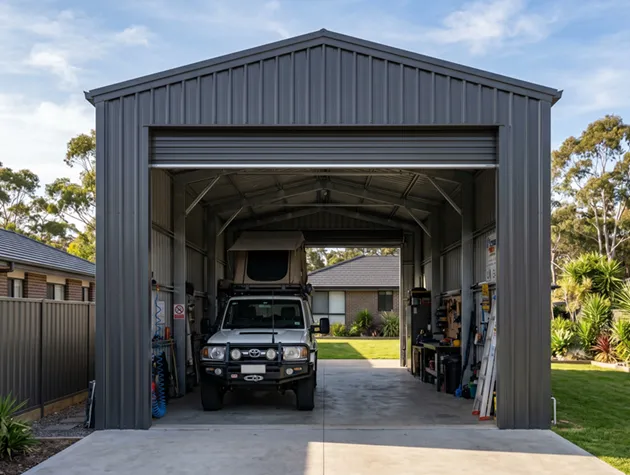
4WD with roof rack, roof tent, or roof bars: 2.4 to 2.7 metres depending on the specific setup. Measure your actual vehicle with the fittings installed, not the base vehicle specification.
Caravan: most caravans sit between 2.7 and 3.2 metres depending on the roof profile, aircon unit, and any roof accessories. Measure your specific van, not the manufacturer's base spec.
Motorhome: 3.0 to 3.6 metres. High-profile motorhomes can exceed 3.5 metres.
Horse float: 3.0 metres minimum. Gooseneck floats with taller profiles may need more.
Tractor with ROPS rollbar: 2.7 to 4.0 metres depending on the machine. Verify with your tractor's documentation. Rollbars often extend above the cab height.
Don't Forget the Tow Hitch
When reversing a trailer or float into a shed, the tow hitch and towbar extend behind the vehicle. The back of the trailer sits lower than the front, and the coupling point rises as the trailer follows the tow vehicle through the door. On some vehicle and trailer combinations, the coupling hardware catches the bottom of the door frame even though the vehicle itself cleared it easily. If you're regularly putting a trailer or float into the shed, factor the tow vehicle and trailer as a system, not separately.
Multiple Vehicles, Multiple Doors
If the shed has more than one roller door, you don't have to use the same height for all of them. A common setup for a domestic workshop is a standard height door for the daily car and a taller door for the ute, 4WD, or boat. Getting different heights for different bays is straightforward at the design stage and costs far less than rectifying it after construction.
Clearance for Forklifts and Commercial Equipment
For commercial and industrial sheds, the relevant clearance is your maximum equipment height plus a working margin. Most counterbalance forklifts with mast lowered sit between 2.2 and 2.7 metres, but with load or in transition the mast may extend higher. Verify your specific equipment specifications, add at least 300mm of margin, and use that number as your minimum door opening.
Upspec Gets This Right at the Design Stage
Upspec discusses vehicle and equipment clearance requirements at the first consultation on every project. We'd rather spend five minutes on this conversation before design than have a client come back after the build. If you're not sure what height you need, tell us what you're putting in the shed and we'll work backwards from there. Call 1300 487 773 or request a free quote online and we'll make sure the design fits everything you need to fit inside it.


